

What is the EUR.1 Certificate and Why Does It Matter in Export?
📌 Introduction

Your goods are packed, the truck is ready, the buyer is waiting—and then comes the call: “We can't proceed with customs clearance. The EUR.1 certificate is missing.”
Many exporters only hear about the EUR.1 certificate when a problem already arises. Yet this document can significantly reduce customs duties, if issued correctly—and if you're eligible to use it in the first place.
What is the EUR.1 Certificate?
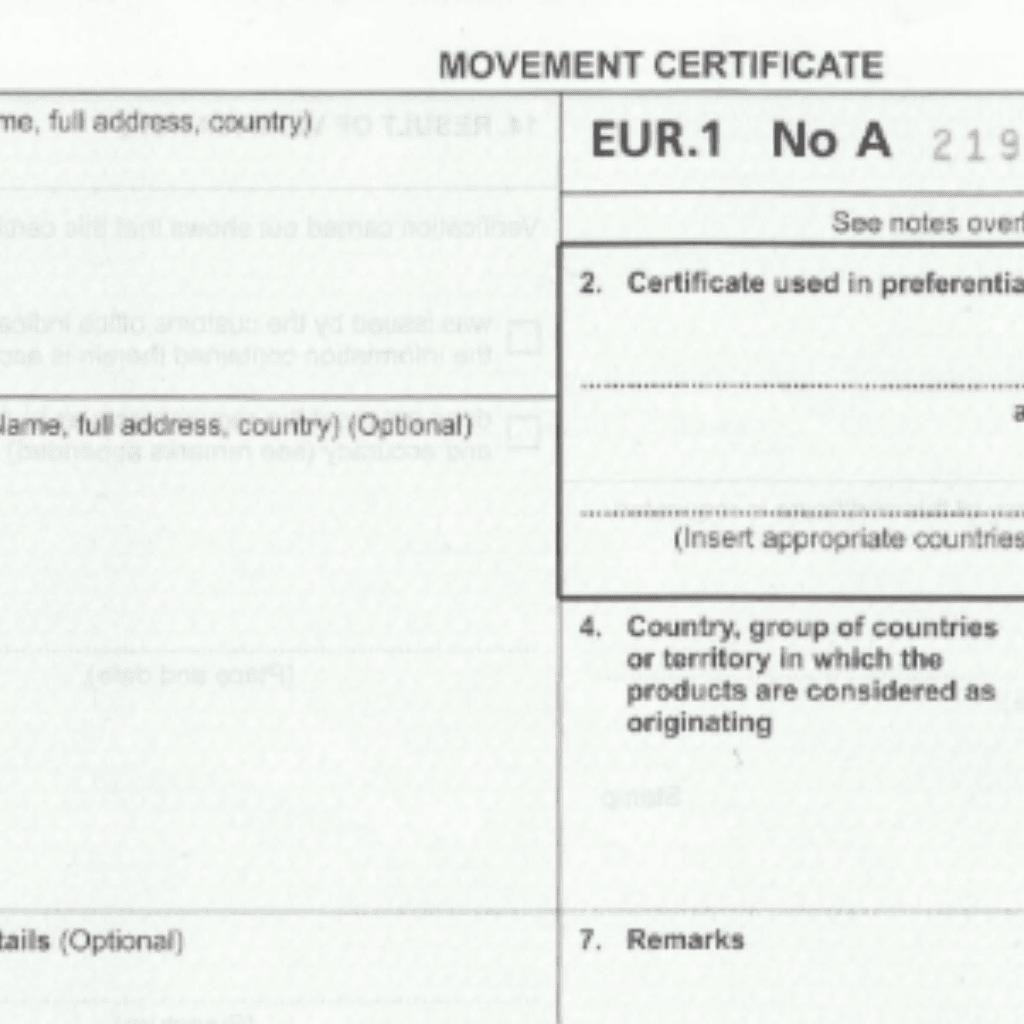
The EUR.1 movement certificate is a customs document used to obtain tariff preferences when exporting goods from the European Union to a partner country that has a preferential trade agreement with the EU.
✅ When accepted by the importing country, the EUR.1 can lead to reduced or even zero import duties for your customer.
It’s important to understand that the certificate confirms the preferential origin of goods—not just any EU origin.
When is the EUR.1 Required—and When Is It Not?
The EUR.1 can only be used under certain conditions:
When is the EUR.1 Required—and When Is It Not?
When you CAN use EUR.1
- ✅ You are exporting to a country with a valid preferential trade agreement with the EU.
- ✅ Your goods comply with the origin rules of that agreement.
When you CANNOT use EUR.1
- ❌ Some countries do not accept EUR.1 and require invoice declarations instead (e.g. United Kingdom, South Korea).
- ❌ If your goods don’t meet the origin criteria, you are not allowed to use EUR.1.
How to Request an EUR.1 Certificate?
- 1
Apply during export clearance
EUR.1 is issued by the customs authorities during export clearance.
- 2
Submit the required documents
The exporter must submit: a completed EUR.1 form (paper-based or electronic, where available), valid supplier or manufacturer declarations proving origin, and the commercial invoice and shipping documents.
- 3
Take responsibility for the data
The exporter is legally responsible for the accuracy of all submitted data.
Post-Clearance EUR.1 and Amendments
- EUR.1 can be issued retroactively, if it was missed during export—provided the goods qualified for origin at the time of export.
- Amendments are possible, but only if: the original document is returned, and the importer agrees to the correction.
Key Risks and Liabilities for Exporters
Customs authorities only check the existence of the document—not its content.
If false or inaccurate data is included (even unintentionally), it can lead to:
- fines or back-payments of duties,
- loss of client trust,
- potential legal consequences.
Common issues that get exporters in trouble
Incorrect or outdated supplier declarations
The EUR.1 may rest on origin proof that no longer holds.
Documents issued for non-originating goods
The certificate is invalid and the preference can be revoked.
Misunderstanding of origin rules
You apply EUR.1 where you are not entitled to.
Why the Certificate Also Matters for Importers
Whether you're exporting or importing, origin matters:
- As an exporter, clarify in the sales contract who is responsible for providing the EUR.1 and whether the goods are eligible.
- As an importer, make sure your supplier provides valid documentation. If not, you may lose the right to tariff preference and have to pay full customs duties.
Key terms
- EUR.1 movement certificate
- A customs document used to obtain tariff preferences when exporting goods from the European Union to a partner country that has a preferential trade agreement with the EU. It confirms the preferential origin of goods—not just any EU origin.
- Preferential origin
- Origin status that qualifies goods for reduced or zero import duties under a preferential trade agreement; distinct from merely being of EU origin.
- Pan-Euro-Mediterranean region
- Currently the main area where EUR.1 is commonly used; new origin rules will take effect from 2026.
Conclusion
The EUR.1 certificate is a small form—but it can have a big financial impact.
If you’re unsure about your eligibility, the correct procedure, or the required documents, don't take risks. Seek expert guidance to avoid customs delays or penalties.
Related articles
Frequently asked questions about the EUR.1 certificate
What is the EUR.1 certificate?
When can I use the EUR.1, and when can I not?
How do I request an EUR.1 certificate?
Can an EUR.1 be issued after export or amended later?
Who is liable if the EUR.1 contains incorrect data?
Not sure if you qualify for EUR.1?
Seek expert guidance to avoid customs delays or penalties—and to make sure your goods get the tariff preference they’re entitled to.
Contact us for expert assistance